
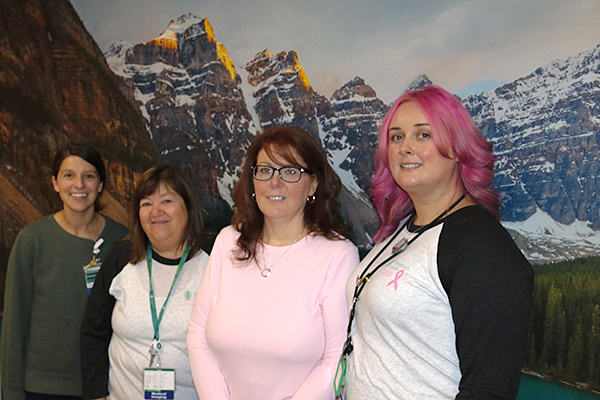
In honor of Breast Cancer Awareness Month, we talk to a patient about the importance of mammograms.
Claremont, NH – Dawn Lawrence had no symptoms of breast cancer and no known family history of the disease when a routine mammogram at age 40 revealed cancer. More than a decade later, she is cancer-free and has a message for anyone putting off a mammogram: get it done.
Lawrence’s experience highlights the importance of breast cancer screening during Breast Cancer Awareness Month, observed each October. Her cancer was detected in 2012 at Dartmouth Health’s Valley Regional Hospital (VRH), despite her not feeling a lump or noticing any changes.
“I did not feel a thing,” Lawrence said. “My breast cancer was contained within the milk duct, so it was pretty deep in there.”
After her diagnosis, Lawrence underwent 33 radiation treatments at Dartmouth Cancer Center. She credits her family, co-workers, and care team with helping her through treatment. Today, she continues to receive annual screenings at VRH and encourages others to do the same.
“Would I forego this test for what I was diagnosed with? Absolutely not,” Lawrence said.
Nicole Lucier, lead mammographer at VRH, reiterated that screening can help detect breast cancer before symptoms develop. One in eight women will develop breast cancer in their lifetime, according to the American Cancer Society, which also reports that the breast cancer death rate has declined 44% since 1989.
“I’ve been doing mammography for about 10 years, and the majority of my patients tell me that the exam was much easier than they thought it would be,” Lucier said.
A screening mammogram typically involves four images, with two views of each breast. Compression lasts about 30 seconds for each image, and patients can ask the mammographer to adjust the compression if it becomes uncomfortable.
Lucier encourages people who feel anxious about the exam to discuss their concerns with their healthcare provider and schedule a screening appropriate for their age and individual risk.
People who notice breast changes, including a lump, skin changes, nipple discharge or a newly inverted nipple, should contact a healthcare provider and should not wait for a routine screening.
Lawrence knows firsthand how easy it can be to assume nothing is wrong when there are no obvious signs. She now makes a point of asking friends, and even strangers, whether they have scheduled their mammograms.
“I tell everyone, everyone should go,” she said.
To learn more about mammography services at VRH, visit vrh.org/service/preventative-screening/mammography.
Broadcast-quality video and audio can be found here. This video content is cleared for use by media outlets on all digital and broadcast platforms, with credit to Dartmouth Health.